The castle of Barletta is the architectural result of successive stratifications by different dynasties that ruled from the 11th century to the 18th century.
Once a fortress for defensive purposes, surrounded by the sea, with the moat encircling the castle and isolating it from potential enemy attacks, it constituted a strategic point in the life of the city as well as an essential urban cornerstone.
Travelling around this region, you inevitably hear about this Renaissance man - Frederick II.
Presumed bust of Frederick II in limestone, dating back to the 13th century.
Today, Barletta Castle is home to the municipal library, the civic museum and a conference and exhibition hall.
We left the Castle for our visit to Cannae.
Cannae - archaeological Park
The site of the Battle of Cannae, where the Roman Republic and Carthage fought on 2 August 216 BCE, is near the ancient village of Cannae. The Carthaginians and their allies, led by Hannibal, surrounded and practically annihilated a larger Roman and Italian army. It is regarded as one of the most extraordinary tactical feats in military history and one of the worst defeats in Roman history. It cemented Hannibal's reputation as one of antiquity's greatest tacticians.
ongoing excavations for the medieval citadel
Head of Medusa in the Museum
Oinochoe*, Terracotta, Etruria, 640 -620 BCE *oinochoe - wine pitcher or jug characterised by a curved handle extending from the lip to the shoulder, and a round or trefoil mouth.
This wonderfully preserved smiling face can be seen here in Australia. Where? You may ask? At the RN Milns Antiquities Museum at The University of Queensland. See if you can spot any more treasures. 
Castel del Monte
Castel del Monte is a citadel and castle built during the 1240s by King Frederick II, who inherited the lands from his mother, Constance of Sicily. The castle is famous for its bold octagonal plan and classicising architectural details.
Having heard so much about Frederick II, I want to talk about this remarkable man. Frederick was the second of Emperor Henry VI of the Hohenstaufen dynasty (second son of Emperor Frederick Barbarossa) and Queen Constance I of Sicily and the Hauteville dynasty. He was born on 26 December 1194, and lived until 13 December 1250. He was King of Sicily from 1198, King of Germany from 1212, King of Italy and Holy Roman Emperor from 1220 and King of Jerusalem from 1225.
Contemporary portrait of Frederick II from the 'Manfred Manuscript'
Frederick was one of the most brilliant and influential figures of the Middle Ages and ruled a vast area, beginning with Sicily and extending through Italy to Germany.
For his many-sided activities, dynamic personality and talents, Frederick II has been called the greatest of all German emperors, perhaps even of all medieval rulers. He built upon the work of his Norman predecessors and forged an early absolutist state bound together by an efficient secular bureaucracy. He was known to his contemporaries as Stupor mundi for his incredible accomplishments, enjoying a reputation as a Renaissance man and polymath, a visionary statesman, an inspiring naturalist, scholar, mathematician, architect, poet and composer. Not only that, but he also spoke six languages.
As an avid patron of science and the arts, Frederick II played a significant role in promoting literature and poetry. He was also the first monarch to formally outlaw trial by ordeal.
Frederick II's complex political and cultural legacy has continued to attract fierce debate and fascination to this day.
View through the window
So many arches and not forgetting comfort...
...Fireplace
 |
In Medieval times, when the fire was lit, condensation formed on the marble walls, dripped into the groove at the base of the wall, then over the steps into a hole in the ground, from which the water was collected. |
executed with great skill and foresight
and not forgetting the plumbing, as in the toilet
One last look out of this unforgettable castle
Goodbye, Castle del Monte
In 1996, Castle del Monte was named a World Heritage Site by UNESCO, which describes it as 'a unique masterpiece of medieval military architecture'.
Friday, 31 October
Today, we visited Bari and continued to Bitonto.
Bari
from octagonal to pointed -
Castello Normanno-Svevo
This Norman-Swabian castle has stood on the edge of the old city of Bari since 1131. Its imposing fortress walls are armed with large bastions, and surrounded on three of its four sides by a deep moat. The castle is encircled by the picturesque gardens of Isabel of Aragon.
from pointed to rounded -
Cattedrale di Bari


Bari street atmosphere


Cattedrale San Nicola

Bari seaside

arches and underground walkways
Bitonto - Angioina Tower
The Angioina Tower of Bitono is the only remnant of the castle built by the Angioina dynasty in the 13th century. The tower represented a strategic point both militarily and economically. It primarily served a defensive function and was part of the fortification system surrounding the city. It was also a symbol of Angioin power, built to assert the king's presence and control over the territory.
Duomo di Bitonto

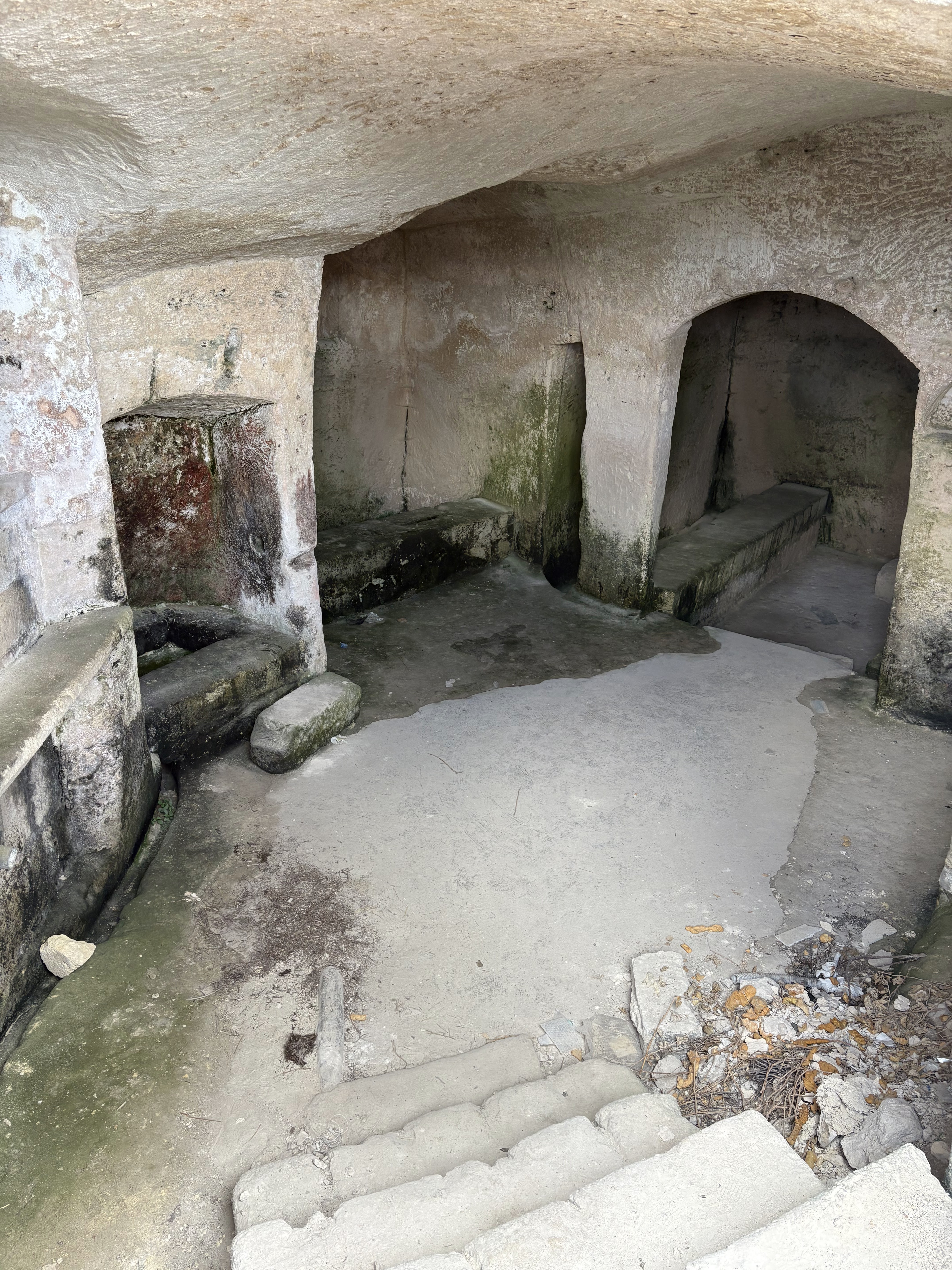
This early Christian basilica has been used continuously until the 7th-11th centuries.
The floor mosaic depicts a mythic monster whose double nature stands out (a bird's head and wings and a feline body), symbolising, in Christian art, the divine and human.
 |
early Christian mosaic of the 5th-6th CE
|

Basilica pilar of the early Christian Age
early grave
Goodbye, Trani
Saturday, 1 November
We departed Bari by coach for Vietri sul Mare via Venosa and Melfi Castle.
Venosa
Vernosa, another historic town, is known for its Roman ruins in the Parco Archeologico, a medieval abbey, and its connection to the poet Horace.
Parco Archeologico
The public baths complex, only partially excavated, consists of a series of rooms arranged along an axial plan, as was typical during the early imperial period. The current layout is the result of a complete restoration in the 2nd century.
 |
| floor mosaic |
The frigidarium, the cold room for cold baths, has a pool with a semi-circular exedra and a rich mosaic floor, dating back to the late 3rd-4th century.

The tepidarium (heated room), the laconicum (dry-sweating room), and the caldarium are still visible. These rooms still retain portions of their suspensurae, the floors suspended on brick stacks or pillars (pilae) that enabled the circulation of hot air generated in the praeafurnia (furnace).
Abbey of Santissima Trinità
 |
| staircase |
the old Church
The construction date of the old monastery is unknown, but some elements may date from the 8th century.
interior of the old monastery
remnants of floor layers from different centuries
Melfi
The centrality of the Melfese area in the communication system among the different regions of Southern Italy, along with the fertility of the fields and the availability of water, encouraged the settlement of the Italic population on hills since protohistoric times.
By the end of the 7th century BCE, the population in this area had increased, and new settlement types had emerged. The inhabitants scattered shanties along the land for agriculture, remnants of which can be seen in Melfi Castle.
Current-day instructions on children's education
approaching Melfi Castle
Treasures from the 6th-5th centuries BCE
Plate with Female Face, Terracotta, Apulia, 500 - 400 BCE
This plate with the Female Face appears to be part of the Melfi Castle collection. Alas, it is housed in Brisbane, at the RN Milns Antiquity Museum.
Two marble sarcophagi testify to the prosperity and sophistication of the major landowners in imperial Rome. They allow a reconstruction of a multi-faceted picture of social, political and economic ties in the region under the Emperors Marcus Aurelius and Commododus in the final decade of the second century.
Sarcophagus from Atella
 |
episodes from the myth of Achilles at Skyros decorate the coffin
Sarcophagus from Rapolla |
 |
1. Apollo, 2. Ares, 3. Selene, 4. Achille, 5. Agamemnon
Tombs of two warriors
 | candelabria in bronze, possibly Etruscan
where the treasures where found
 |


approaching the coast with the background of Mt Vesuvius |
Vietri sul Mare
View from our balcony at Hotel Lloyd's Baia
Sunday, 2 November
We started with a guided visit to Tenuta Vannulo, the first organic producer of bufala (water buffalo) milk, and its mozzarella production.
We visited the cheese-processing area, the stable, and the agricultural museum, and concluded our visit with an exquisite mozzarella-tasting lunch.
contented buffalo enjoying back rubs
Buffalo milk production
happy workers in the process of mozzarella production
vintage 1945 in the museum
Paestum
Quoting Nietzsche on seeing Paestum:
'It is as if a god had built his house here with huge blocks of stone.'
We spent the afternoon visiting the archaeological site of Paestum, a site totally open to the public. Paestum contains three of the best-preserved ancient Greek temples in the world. This includes the two Hera Temples below.
Paestum was a major ancient Greek city on the coast of the Tyrrhenian Sea, in Magna Graecia. Its ruins are famous for their three ancient Greek temples in the Doric order, dating from about 550-450 BCE. They are in an excellent state of preservation, which has me unable to stop taking photos. Perhaps you might share my exalted indulgence.
Temple known as the Basilica
Paestum was established around 600 BCE by settlers from Sybaris, a Greek colony in southern Italy, under the name of Poseidonia. The city thrived as a Greek settlement for about two centuries, witnessing the development of democracy. In 400 BCE, the Lucanians seized the town. The Romans took over in 273 BCE, renaming it Paestum and establishing a Latin colony. Temple of Neptune
Temple of Neptune interior
Shifts in trade routes and the onset of flooding and marsh formation caused Paestum's decline. The town became a bishopric, but was abandoned in the Early Middle Ages, left undisturbed and largely forgotten until the 18th century.
a road less travelled
until Geoff's discovery
Today, the remains of the town are part of the Province of Salerno, in the region of Campania.
amazing arches
a happy fellow travellerin need of a rest
The National Archaeological Museum of Paestum
This Museum holds highlights from the mouth of the Sele river: the Sele Archaic metopes, relief panels of the temple dedicated to Hera, from around the 6th century BCE. The displays also show large painted terracotta architectural fragments from the temples and other buildings, Greek Terracotta figures, incomplete larger terracotta statues, and pottery, including painted vases.
Locally made statuettes of a goddess (Hera?) seated on a throne with her right hand on her chest holding a lotus flower (late 6th-5th century BCE)
Sanctuary of Hera on the river Sele (late 5th C BCE)
Zeus and Hera, the divine couple and the symbol of sacred marriage,
seated on a single throne.
Paestum is renowned for its painted tombs from the Lucanian period. However, the most famous dates to the Greek period: the Tomb of the Diver (Tomba del tuffatore), dating to the middle of the 5th century BCE, the Golden Age of the Greek town.
Tomb of the Diver, covering slab, c 470 BCE
The tomb was found on 3 June 1968, in a small necropolis, some 1.5 km south of the ancient walls. The tomb is painted with an accurate fresco technique; its importance lies in being the only example of Greek painting with figured scenes from the Orientalising, Archaic, or Classical periods to survive intact. Among the thousands of Greek tombs known from this time (roughly 700-400 BCE), this is the only one found to have been decorated with frescoes of human subjects.
Scholars are divided on the meaning of the diver; it would appear that the celebration of life may include a suggestion of the afterlife. As such, the diver could be suspended between heaven and earth.
hedonistic celebration of life

Following the flute player
While the National Archaeological Museum of Paestum holds the most extensive collection, many significant pieces were removed from the site before modern conservation methods were implemented. Statues, vases and painted pottery are held in the Louvre, in Madrid, Berlin, and other museums in Europe and America.
The Antikensammlung Berlin holds this Paestum bell krater:
Odysseus and Sirens, painted by Python, c 330 BCE
The RN Milns Antiquities Museum holds this Campanian bell krater: 
Maenad*, Terracotta, c 375-350 BCE
*maenads - female followers of Bacchus
I see dead people...Gaudo culture (3,500-2,500 BCE)
The Gaudo culture is one of the most important cultures in Italian prehistory and played a key role in Campania between the mid-4th and the first half of the 3rd millennium BCE (the Copper Age). Tombs are the main form of evidence left by the Gaudo peoples. They are collective burials cut into the bedrock ('grotticella' tombs) containing individuals who were not always linked by kinship ties. The tomb was not just a commemorative monument for the deceased but also a space to celebrate the community's cohesiveness.
Female Statuette, made of Terracotta, Neolithic, Paestum, (5,000-4,500 BCE)
This statuette portrays a 'Neolithic Venus'. The preserved parts of the abdomen and legs suggest that this figurine was seated.
'Neolithic Venuses' are marked by large breasts and wide hips. These figurines were widespread during the Neolithic and are often found in ovens or hearths to emphasise their function as protectors of the home, or beneath floors as part of a foundation ritual. 'Neolithic Venuses' are generally interpreted as cult images, closely linked to the fertility and fecundity of both humans and the fields.
Mother goddess figurine, Amlash culture, Iron Age, c 1,000 BCE
I recently came across this female pottery with red paint figurine from Iran at the Abbey Museum in Caboolture, Qld.
After another rich day, so rich with archaeological sights and treasures, enhanced by Dr Estelle's commentaries, we return to our hotel in Vietri sul Mare.Back at our hotel
view into the other direction
Monday, 3 November
Before we reached Naples by coach, we visited Herculaneum and Oplontis.
Herculaneum
Depending on the source, the origins of Herculaneum are attributed to either the Greek hero Heracles or the Oscans around the 7th century BCE. The Etruscan took control of the area and were later overthrown by the Greeks. The Greeks named the town Heraklion and used it as a trading port because of its proximity to the Gulf of Naples. In the 4th century BCE, Herculaneum came under Samnite domination.
In the 2nd century BCE, the city walls were built (between 2 and 3 metres thick), primarily of large pebbles, except for the coastal section.
Herculaneum participated in the Social War (91-88 BCE) on the side of the 'Allies' against Rome and was defeated by Titus Didius, a legate of Sulla. Following the war, the walls lost their protective purpose and were integrated into houses and adjacent structures.
Herculaneum became a Roman municipium in 89 BCE. The eruption of Mount Vesuvius in 79 buried Herculaneum under approximately 20 m of ash. Pompeii, which we will visit on Tuesday, 4 November, was primarily buried by a thick layer of volcanic ash and lapilli. Herculaneum disappeared under pyroclastic surges and flows. These sites have been progressively excavated and made accessible to the public since the mid-18th century. However, a large area of Herculaneum still lies under the modern town of Ercolano.
military dinghy, over 9 m long, 2.2 m wide
Herculaneum is the only city in the Roman world with a practically preserved ancient seafront. Today's remains are a testimony to the luxurious living arrangements of its inhabitants.
bathing culture
spectacular mosaic flooring
central baths - men's section tepidarium -
mosaic floor with Triton and dolphins
central baths - women's section
shelves and a bench, made of rosso antico marble -
to leave clothes and objects
mosaic floor with meander motifs
frescos
The College of the Augustales interior
detail of the interior decoration of one of the arches -
and arch leading into the area of the Forum
Excavations continued sporadically up to the present, and today many streets and buildings are visible, although over 75% of the town remains buried.
archaeological work in progress
street paving stones
interior decorations
frescoes in the House of the Grand Portal
House of the Wooden Screen cubiculum
Grande Taberna sales counter
courtyard with a well
central pool in the atrium of the House of the Bicentenary
Samnite house atrium with impluvium (pool for collecting rainwater)
House of Neptune and Amphitrite - summer triclinium
The floor was designed to accommodate the banquet beds, arranged around a rectangular pool with water spouting forth to provide a cooler environment.
grocery store
2013 sculpture in ancient setting
new excavations
steps
sophisticated interior
wine, dine, be merry...
Today, the towns of Ercolano and Portici lie above Herculaneum.
Ercolano was called Resina until 1969, when the modern name was adopted in honour of the old city.
Goodbye Herculaneum
We'll spend the afternoon in Oplontis, present-day Torre Annunziata.
Oplontis
Known as Villa Poppea, this grandiose maritime villa was first built in the 50s BCE, and then expanded in stages. The oldest part centres around the atrium with the triclinium (dining room) and other reception rooms. It is believed that Nero's second wife, Poppea, resided here when away from Rome.
hidden well below Torre Annunziata
the villa's colonnade
Geoff had enough
it's a long way up
corner of the triclinium
frescoes
detail of a tragic mask and a peacock
sculpture without head
storage area
Atrium
can you spot Geoff in the distance?
Goodbye, Oplontis
We arrived in Napoli, where our evening concluded with a delicious dinner, courtesy of Academy Travel.
Buonasera, Napoli
view from our balcony -
Grand Hotel Santa Lucia
view towards Mt Vesuvius -
Tuesday, 4 November
Full-day excursion to Pompeii
Pompeii
While Pompeii needs no introduction, it is interesting to note that the ancient city developed from a small town that already existed in the 8th century BCE. To avoid falling into the hands of the Etruscans in the 6th century BCE, Pompeii entered into an alliance with the Cumaeans of Greek origin. However, the Etruscans still conquered Pompeii, which they dominated from 525 to 474 BCE, when they were defeated by the Greeks at the battle of Cumae. The influence of these great civilisations is clearly visible in the architecture, pottery and art.
The House of Venus in the Shell
Pompeii was next conquered by the Samnites, an Italic population from the interior of the region. In the following century, Roman troops conquered Campania, and by the end of the Samnite Wars (343-290 BCE), they dominated the entire region. Various conflicts and revolts led to Pompeii becoming a Roman municipality and later a Roman colony, which soon adopted Roman customs, replacing the hitherto Italic customs.
Unlike Herculaneum and other towns in the area, which were buried under a river of mud when Vesuvius erupted, Pompeii was hit by a gigantic cloud of poisonous gases, ash, lapilli and white-hot stones that buried monuments and human beings alike under a layer of debris as much as 7 m deep.
The Vettius House: lararium
some skills don't change
Reconstruction of a warp-weighted loom. The existence of this kind of loom has been recorded since the Early Bronze Age.
Having Dr Estelle guide us through Pompeii added another dimension to our visit, as these digs are her expertise. Pompeii, with its well-preserved buildings in an excavated area of 44 ha, is the only archaeological site in the world to provide a complete picture of ancient Roman life. Avoiding the crowds of visitors, Dr Estelle took us to an area newly excavated and still under work.
the ever-present volcano
Indeed, one of the sites was so recently explored that the former Chancellor of Germany, Angela Merkel, visited. At one stage, she was heading our way. Being so excited to see her, I spontaneously reached out to compliment her. Alas, her young, blond, sturdy X-built minder left absolutely no shadow of a doubt that that was not going to happen. I was so deflated, I didn't even take a photo of her. Here are the photos I took instead:
fresco
in detail
mosaic of Alexander's Battle The Tragic Poet's House: entrance dog grinding its teeth: 'cave cane' (beware of the dog)
shop bench
The bench, covered by opus sectile (segments of polychrome marbles composing a geometrical design), still contains original dolia (terracotta receptacles). In one of them, earnings were found, mainly coins of little value.
On the wall to the right of the bench is a painted lararium (shrine) shaped like a small temple with Corinthian columns. In the middle are the house-gods, and on the two sides are Mercury and Dionysus, protectors of commerce and wine.
the owner advertising his goods? Priapus weighing his phallus tricky irrigation system
Apsidal calidarium
surrounding landscape
a quiet spot where we had lunch
Our tour director, Ilaria, organised a picnic lunch away from the crowd in a beautifully secluded spot near the sites we visited.
near where we had our lunch
House of the Vettii
Freed Pompeii Slaves
archway into the underworld typical structure of Pompeiian roads
Mt Vesuvius
The Temple of Jupiter
After a whole day of absorbing the epic Pompeian atmosphere, we returned to our very comfortable suite and another delicious dinner with fellow travellers.
Wednesday, 5 November
Naples
After a morning talk with slides by Dr Estelle, we departed for Naples Underground, San Lorenzo Maggiore Neapolis Sotterrata.
ruins underneath Naples
Naples street scenes...
limone, limoncello...
a reminder of life's brevity
entrance to the underground
San Lorenzo Maggiore is a church located at the precise geographic centre of the historic centre of the ancient Greek-Roman city. The Macellum of Naples was the ancient Roman market beneath the church.
While a specific date for Neapolis' founding cannot be established, archaeological studies indicate a date in the late 6th-early 5th century BCE. The initial settlers came from the city of Cuma, followed by the Calcidesi, Pithecusans (today's citizens of Ischia) and the Athenians. The urban layout of Neapolis is structured in a regular network of streets.
Marcellum of Naples -
ancient Roman market beneath the church
vaulted ceilings
pretending to be local citizens
monument of Dante Alighieri in Piazza Dante
shopping mall in Galleria Umberto
coffee or gelato?
Aperol Spritz!
the dome of the shopping mall
on our way home
the omnipresent mountain
sunset from our balcony
Thursday, 6 November
The National Archaeological Museum of Naples
We spent the morning visiting this impressive museum. Its collection includes works from Greek and Roman antiquities, especially Roman artifacts from the nearby Pompeii, Stabiae and Herculaneum sites. The museum's Mosaic Collection includes numerous vital mosaics discovered in the ruins of the Vesuvian city, dating from 100 BCE. The Farnese Collection forms the core of its art treasures. The museum also houses an extensive collection of Renaissance art.
Io and Argos, Pompeii, House of Meleagro, 62-79 AD
Io, identifiable by the bovine horns, is kept under surveillance by Argos to prevent Zeus from seducing her, as requested by Hera.
Ares and Aphrodite, Pompeii, House of Meleagro, 62-79 AD
The couple of divine lovers, with Cupids holding the god's helmet and the goddess's toilet box.
 |
Terentius and his wife, Pompeii, House of Terentius Neo, 55-79 AD
|
Portrait of the baker Terentius Neo and his wife in an intellectual pose. It is perhaps the only one of its kind discovered in the Vesuvian cities.
Sappho, Pompeii, Insula Occidentalis, 55-79 AD One of the most famous Pompeian frescos is the medallion of the portrait of Sappho, dating to the Neronian period. It depicts a female face who holds a stylus thoughtfully to her lips, the ideal 'type' of intellectual woman. In this fresco, as in the portrait of Terentius Nero and his wife, the writing implements are used to identify the characters as members of the literate middle class.
Young man holding a roll, Pompeii, House of the Caenaculum, 50-79 AD
The young 'poet' has been awarded a wreath because he participated in a literary competition, as indicated by the word Plato written on the tag hanging from the papyrus roll.
Young man holding a roll, Pompeii, House of the Caenaculum, 50-79 AD
The similarity between their faces suggests that this young man is the 'brother' of the previous one, who appears to be younger. He has possibly been awarded in an epic poetry competition, since the word Homerus is written on the tag hanging from the papyrus roll.
Donna, Stabiae, Ariadne's Villa, 54-69 AD
Seated woman who is pondering.
Akte or Peliade, Herculaneum, 20-10 BCE
Face of a girl, a female figure in a painting depicting a sacrifice scene (perhaps the arrival of Jason at Iolco).
I believe it is of interest to include here an account of how the Greek 'colonisation' of southern Italy and Sicily evolved.
routes of migration
The Greek 'colonisation' of southern Italy and Sicily
The phenomenon of migration followed in the wake of the experiences of the early Greek navigators who, in the Iron Age, started to rediscover the westward routes in search of raw materials, exploring the fertile lands of what was then called Hesperia, namely the region where the sun sets, and to form complex social and commercial relations with the local populations. The migratory movement was not instantaneous and unified but began, over the course of the two centuries, from individual cities or regions in Greece.
The first settlers to establish themselves in southern Italy and Sicily came mainly from Euboea, the Gulf of Corinth, and the Peloponnese. In less than a century, they founded numerous settlements, from the oldest of Pithekoussai, on the island of Ischia, in the first half of the 8th century BCE, to that of Siris-Polieion in Basilicata early in the following century.
The origins and profound motivations of the phenomenon of 'colonisation' can be traced to internal political crises or to problems caused by overpopulation or the scarcity of agricultural and food resources. Very often, those who left their homelands were forced to do so by the community to which they belonged. In some cases, they were even chosen by lot, ensuring the survival of those who remained.
Once they landed on the coasts of southern Italy, the various contingents of colonists established multiple modes of contact and exchange with the pre-existing local populations, thus contributing to the creation over time of the specific forms of the newly founded poleis (cities).
The Dancers of Ruvo, Ruvo, Puglia, late 5th-early 4th century BCE
moving towards the east?
Procession of eight women, all depicted in profile and dressed in long chitons and cloaks covering their heads in bright, multi-colours (ochre, red, blue, and black). The figures are moving to the right, with their hands interlinked, and each has a foot raised in a dance step.
The scene depicts a very ancient funerary ritual, a threnos. This involved dances and choral laments performed while the body of the deceased was displayed and while the funerary procession proceeded to the tomb. The chorus of women holding hands evokes, on a mythological level, the merry dance that Theseus and the young Athenians performed in Crete to celebrate the death of the Minotaur. If, however, as in this case, it refers to a funerary context, they allude directly to the social and political prestige of the departed. Moreover, the adoption of an Attic-inspired theme in an Apulian burial towards the end of the 5th century BCE reflects the political events of those years, during which Athens collaborated with the indigenous centres of Puglia to stop the dangerous growth of Tarantum's power.
Women's Procession of Offerings, Australia, 1964
moving towards the west?
Procession of Offerings, Greece, 2012
Pair of earrings, Gold, Taranto, second half of 4th century BCE
Necklace, Gold and garnet, Cumae (?), late 4th-early 3rd centuries BCE
Pair of earrings, Gold and garnet, Cumae (?), 3rd century BCE
Portrait of Faustina, the Elder, Apuan Alps, AD138-161 Head in Luni marble, Faustina, wife of Antoninus Pius, was made during the early phase of his reign. I have a compulsion to include portraits of Faustinas (her namesake is one of the characters featured in my PhD thesis).
Pio Monte della Misericordia
We visited this church, consecrated in 1606, in the historic centre. It is famous for its artworks, including this Caravaggio painted in the year of its consecration.
Caravaggio, The Seven Works of Mercy, 1606Museo di Capodimonte
This is one of the largest art museums in Italy. It was established by Charles of Bourbon in 1738 to accommodate his mother's, Elisabetta Farnese, art collection. The works include Roman sculptures and works by Caravaggio, Raphael, Titian, El Greco, Artemisia Gentileschi, and others.
staircase to the treasures
Titian, Portrait of Pope Paul III, c 1543
El Greco, A Boy Blowing on an Ember to Light a Candle, c 1570-72
Carravaggio, The Flagellation of Christ, c 1607-08
Artemisia Gentileschi, Judith Slaying Holofernes, c 1612-13
Artemisia Gentileschi, Annunciation, 1630
Artemisia Gentileschi, Judith and Her Maidservant, c 1645-50
Sebastiano del Piombo (attr), Shepherd with Flute, 1508-10
Angelica Kauffman, Ferdinando IV and His Family, c 1783
you have to cherish the famous Neapolitan - Sophia Loren
Classically and artistically enhanced by what we had seen, we farewelled the Museo di Capodimonte to indulge in our sumptuous farewell dinner at a restaurant close to our hotel.
Friday, 7 November
Our archaeological and cultural immersion into Puglia and Naples ended with our transfer to Rome Fiumicino airport. We shared an immensely enriching experience with our fellow travellers, and, for our part, Geoff and I will forever have the fondest memories of this well-organised and magical tour.


.jpg)

.jpg)


.HEIC)
.HEIC)
.HEIC)


.HEIC)
.HEIC)
.HEIC)
.HEIC)
.HEIC)

.HEIC)
.HEIC)


.HEIC)
.HEIC)

.HEIC)

.HEIC)

.HEIC)
.HEIC)
.HEIC)
.HEIC)


.HEIC)


.HEIC)
.HEIC)

.HEIC)
.HEIC)


.HEIC)




.HEIC)


.jpg)


